The Quiet Guardian Above the Breakers: Making Sense of Surge Protection at Home
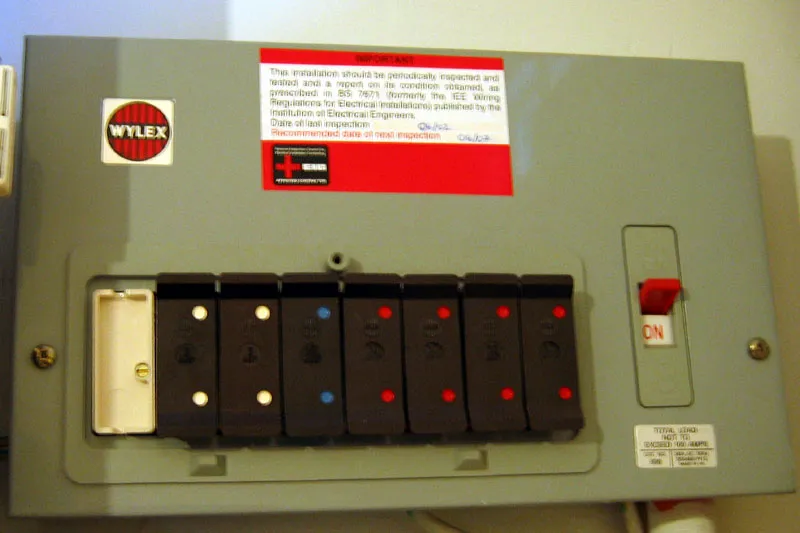
Photo: The original uploader was Secretlondon at English Wikipedia., CC BY-SA 3.0, via Wikimedia Commons
Open your consumer unit and you'll see the usual cast: the main switch, a row of MCBs, an RCD or two. Then, tucked at one end, there's often a narrow device with a small window or a set of coloured indicators that nobody has ever explained to you. That's a surge protective device — an SPD — and it's quietly doing a job that no plug-in strip from a DIY shed can replicate.
What the module is actually there for
A surge protective device sits between your installation and the outside world, ready to divert a very fast, very large voltage spike away from your wiring and down to earth. Think of it as a pressure-relief valve for electricity. It clamps the spike, absorbs the energy, and carries on. You never notice it working, which is precisely the point.
These spikes aren't all dramatic lightning strikes. Plenty arrive on a perfectly ordinary Tuesday: a substation switching operation, a neighbour's fault, a big inductive load kicking in somewhere on the network. Mains-borne transient overvoltage is a real feature of UK supply, and modern homes are packed with electronics that don't much enjoy it — heat pump controllers, inverter drives, smart heating hubs, LED drivers, routers, and the stack of chargers by the hall door.
Why it isn't the same as a surge strip
A plug-in surge protector protects the socket it's plugged into, plus whatever is downstream of it. That's it. It won't shield the boiler's control board, the heat pump's outdoor unit, the hard-wired EV charger, or the smoke alarms.
A consumer-unit SPD works upstream of everything. It covers every circuit on the board, including the ones you can't easily unplug and the ones you'd never think of. It also tends to have a much larger energy-handling capacity than a £15 strip, and it's installed by someone who knows what they're doing rather than balanced on a trailing lead behind the telly.
Don't ditch the strip if it makes you feel better, but understand the scale of what it does. The strip is a seatbelt for one passenger. The SPD is the crumple zone for the whole car.
Has your home already got one?
A quick look will usually tell you. You're looking for a device fitted alongside the breakers with one of these clues:
- A small indicator window showing green, or a coloured band that changes when the device has reached end of life.
- A printed rating on the front such as Type 2, or figures in kV and kA.
- A manufacturer name you don't recognise, often a European brand, sitting at one end of the DIN rail.
- A label on the inside of the lid, or a note on the schedule stuck to the door.
If the board was replaced in the last eight years or so, there's a fair chance it's there — surge protection became a much more standard inclusion under the 18th Edition of the wiring regulations, and most reputable installers now fit it as a matter of course. If your board is older, or was swapped out cheaply by someone who arrived in an unmarked van, it may well be absent.
One caution: don't go poking fingers inside the enclosure to investigate. Look through the lid, take a photo, and ask an electrician if you're unsure. The inside of a consumer unit is a place where curiosity has a body count.
Reading the little window
An SPD has a finite appetite. It absorbs spikes until it can't, then it gives up — usually gracefully, by failing open rather than shorting everything out. Many units show this with a status indicator that changes colour, or a flag that pops out. Some have a remote signal contact that can feed a light or a buzzer, which is genuinely useful in a small business where nobody opens the cupboard under the stairs.
If the window has gone from green to red, the device is spent. It's still safe, but it's no longer protecting anything. Replacement is usually a five-minute job for a competent electrician, because these are designed as swappable modules rather than permanent fittings.
How often should you check? Once a year is plenty for a domestic property — make it part of the same routine as testing your RCDs, and you'll never have to remember it separately.
Where the value really stacks up in 2026
Surge protection makes the most sense in homes where the cost of a failure is high and the inconvenience is worse. That means:
Homes with heat pumps and modern boilers. Control boards and inverter modules are expensive, often slow to source, and not always covered by a manufacturer's warranty if damage is traced to a supply event.
Anyone with an EV charger. The charger itself is hard-wired, its electronics are exposed to whatever the supply throws at it, and a fault usually means the car stays put.
Home-working households. If your income depends on a desktop, a NAS drive and a decent router, the maths is straightforward — the module usually costs less than a single replacement laptop logic board.
Small businesses with tills, EPOS, CCTV or refrigeration controls. A spike that takes out a fridge controller on a Friday afternoon is a very expensive weekend.
Rural and semi-rural properties. Overhead supply lines and longer network runs mean more exposure to the sort of transients that come with weather.
Conversely, if you're in a modern flat with very little plugged in and a replacement cost measured in tens of pounds, it's a nice-to-have rather than a must.
What to ask your electrician
If you're booking any board work — an upgrade, an extra circuit for the charger, a rewire — ask these questions plainly:
- Does the existing board have an SPD fitted, and what type is it?
- What's the status indicator showing, and when was it last checked?
- If there isn't one, what would fitting one involve, and does the enclosure have space on the rail?
- Is the main protective bonding in good order? An SPD needs a solid earth path to divert anything meaningful.
- What's the rated residual voltage, and is the device appropriate for a home with an EV charger or heat pump?
- Is there a warranty on the module, and what does end-of-life replacement cost?
That last one matters more than people expect. Cheap modules cost little to buy and get replaced often. A decent branded unit with a clear indicator and sensible replacement cost is usually the better long-term buy.
The bottom line
Surge protection isn't glamorous and it will never announce itself. It just quietly does its job, in the same way a smoke alarm does, and gets forgotten about until the day it matters. If your consumer unit has one, look at the window once a year and make sure it hasn't retired without telling you. If it doesn't, and you've got a heat pump, a charger or a home office worth protecting, it's a genuinely sensible upgrade — and one of the few electrical jobs where the price is small and the payoff is measured in disasters avoided.
Not sure what you're looking at? Send us a photo of your board and we'll tell you what the silver module is — or isn't — doing.