When the Shower Wins and the Cylinder Sulks: A Load Plan for Busy UK Homes
There is a very British household moment that tends to arrive around this time of year. Someone hops in the shower, someone else switches on the immersion heater because the hot water has run low, and a third person plugs the car in before bed. Nothing explodes. Nothing even necessarily trips. But the lights dip, the shower goes lukewarm, and somewhere in the hallway a consumer unit quietly starts earning its keep.
That is the heart of the high-demand appliance question. An electric shower and an immersion heater are not glamorous gadgets. They are workhorses, and that is exactly why they deserve proper thought. In 2026, with more homes adding heat pumps, EV chargers and electric heating, the supply has more jobs than ever. The aim is not to ban the big draws. It is to make sure they take turns politely.
The maths is less dramatic than the argument
Electrical capacity is usually discussed in amps, but appliances are sold in kilowatts. The conversion is simple enough: amps equals watts divided by 230 volts. An 8.5kW electric shower pulls roughly 37A at full chat. A 3kW immersion heater is about 13A. A 7.4kW home EV charger is around 32A. Add those together and you are already past 80A before the oven, kettle, washing machine or tumble dryer have said a word.
Most UK homes have a single-phase supply with a main fuse in the region of 60A to 100A, though the precise figure depends on the property and the distribution network operator. A modern consumer unit may have plenty of spare ways, but spare ways are not the same as spare capacity. The main fuse, meter tails, consumer unit rating and earthing all need to be considered together. This is why 'there is a slot left' is not a load calculation.
Diversity is useful, but it is not a free pass
Electricians use diversity to estimate how much of the connected load is likely to run at once. It stops us sizing everything for a fantasy moment when every appliance in the house switches on together. In a normal home, the oven, shower, immersion and car charger rarely all peak at the same second.
The catch is that diversity is a planning tool, not a promise. Showers and immersion heaters are both high-current heating loads, and winter routines make overlap more likely. A morning shower while the immersion recovers hot water is a classic. An overnight EV charge combined with an immersion heater on a cheap tariff is another. If those collisions happen often, the supply is being asked to do something the original design may never have anticipated.
Where priority switches earn their keep
This is where load management stops being a buzzword and becomes genuinely useful. Priority switches and load controllers can temporarily pause a lower-priority load when a higher-priority one demands power. Some setups give the shower priority over the immersion heater. Others let an EV charger reduce its charging rate when the house is busy, then ramp back up when the kettle has boiled and the shower has finished.
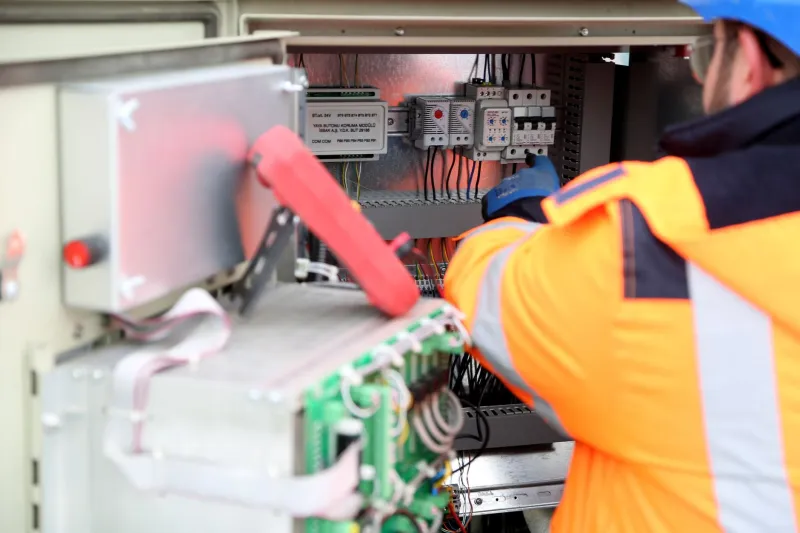
For a homeowner, the appeal is simple: you keep the appliances you already have, and the system manages the awkward overlaps. For a small business, the same logic can stop a staff kitchen, hand dryer and workshop heater from tripping the supply at lunchtime. The important part is that this is designed and installed properly. A relay tucked into a cupboard with no thought for cable ratings, enclosure or testing is not load management. It is a future fault with a schedule.
Warning signs your supply is being pushed
You do not need to wait for a full power cut to notice a strained supply. Look for lights that dip when the shower starts, a shower that loses temperature when another heavy load kicks in, plugs or switches that feel warm, a consumer unit that buzzes, or breakers that trip during predictable routines. A main switch that trips when the immersion and shower overlap is a particularly clear message.
Some of these symptoms can point to a loose connection, a failing device or an earth fault rather than pure overload. That is why the answer is not to keep resetting the breaker and hoping. Repeated tripping, buzzing or warm accessories deserve an electrician's attention. If the main fuse is involved, do not pull it or tamper with it. That is the distribution network operator's equipment.
A 2026 kitchen-table plan
Start by writing down the big loads and their ratings. Include the shower, immersion, EV charger, oven, hob, tumble dryer and any electric heating. Then note when they actually run. A clipboard or a phone note is enough. You are looking for predictable collisions, not perfect precision.
Next, decide whether behaviour change or hardware is the better fix. Timers can move the immersion or EV charge into quieter hours. A priority switch can protect the shower. A proper load calculation can tell you whether the existing supply is comfortable or whether an upgrade needs discussing with the DNO. In some cases, the sensible answer is a dedicated supply for a big new load. In others, it is a smarter controller and a clearer routine.
What you should not do is solve a capacity problem by fitting a bigger breaker. The breaker protects the cable. It does not create more capacity at the main fuse, and it certainly does not make the wiring any younger. A qualified electrician can check the existing installation, confirm the supply arrangements and design a solution that matches how the house is actually used.
The 8kW argument is rarely about one appliance being unreasonable. It is about several reasonable appliances sharing a supply that was sized for a simpler era. A little planning now keeps the shower hot, the cylinder warm and the consumer unit out of the conversation.